


Key Takeaways
The best CSS depends on your goal
Lower costs, more reach and more profit are different jobs, so decide which one you are hiring for first.
Test it, don't trust a ranking
Run the CSS on one clear scope beside your current set-up, with the same dates and the same success measure.
Judge on sales, not clicks
Compare extra sales, cost per sale including every fee, and new customers, not click price on its own.
Question every claim
Ask for the baseline, the sector and the time period behind any result, from any provider.
In short: the best CSS is the one that adds the most profitable sales to your account, at a cost you can check, for a retailer like you. You can’t read that from a ranking or a claim. You can find it with a fair test, so this guide shows how to run one, which numbers to compare and which claims to question.
If you want the full checklist of what a good partner looks like, start with our guide to choosing a CSS partner. This guide picks up from there: once you have a shortlist, how do you find out which one is actually best?
What does “best CSS” actually mean?
A Comparison Shopping Service (CSS) places your Google Shopping ads on your behalf. If the term is new, our introduction to Google CSS explains how it works. “Best” is a different question, because the best CSS depends on what you are trying to achieve.
| If your goal is… | The best CSS for you will… | The number to watch |
|---|---|---|
| Lower the cost of Shopping sales | Win sales for less than your current set-up | Cost per sale, including every fee |
| Reach more shoppers | Get more of your products in front of buyers, including ones that are not selling today | Impressions and sales on those products |
| Grow profit, not just revenue | Work to your margins, not only to a revenue target | Profit after ad cost and fees |
| Keep control in-house | Give your team clear data and leave decisions with you | What you can see, and who changes what |
Pick the row that matches your goal before you talk to any provider. A CSS that is excellent at one of these can be an average fit for another.
How do you run a fair test of the best CSS?
The only reliable way to find the best CSS for your business is to test it on your own products. Here is how to keep the test fair.
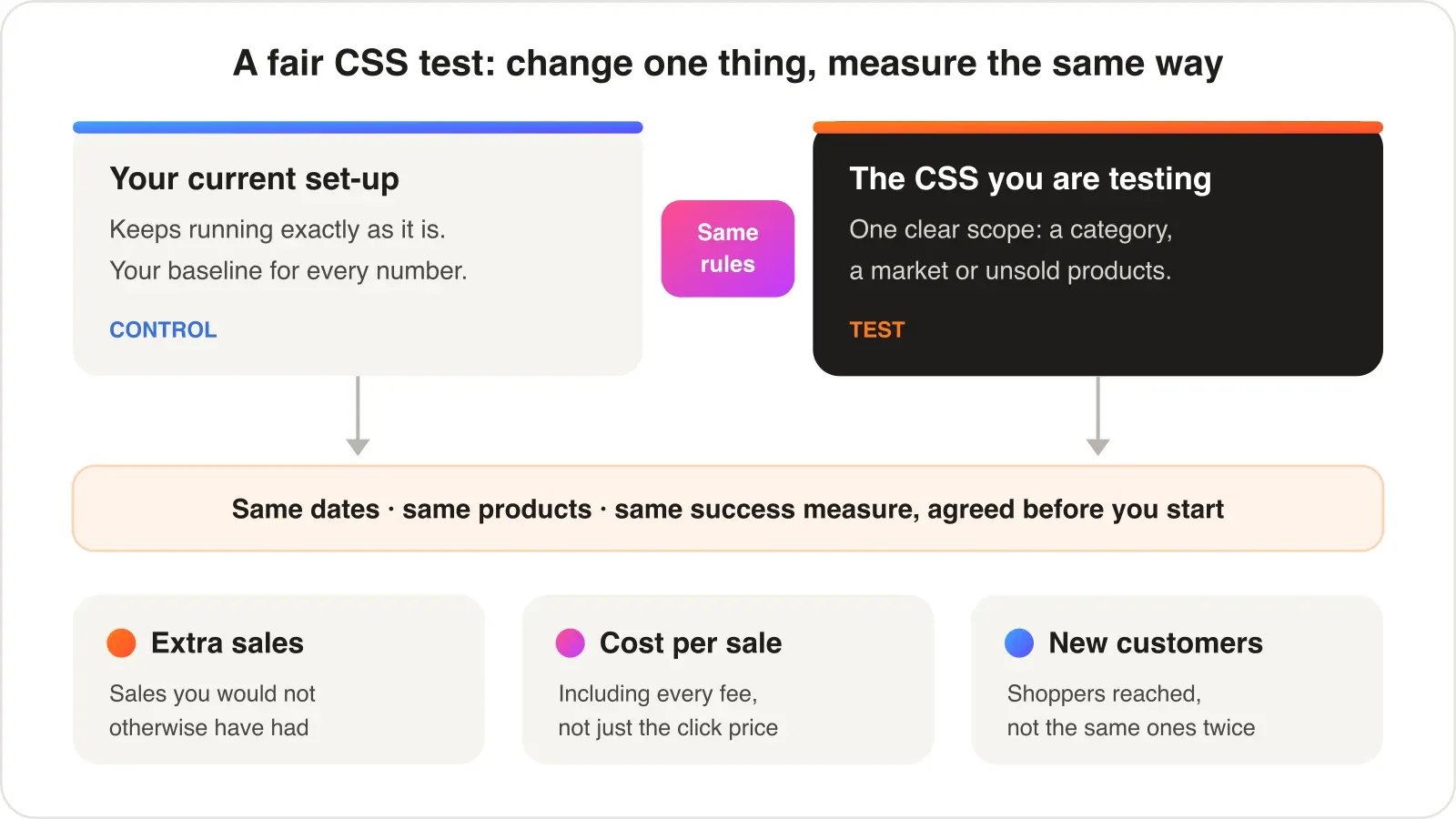
1. Pick one clear scope
Test on one category, one market or one group of products, not your whole catalogue. A small, defined scope makes the result easy to read and keeps the risk low. A good scope is products that are not getting much visibility today, because any sales from them are clearly additional.
2. Keep your current set-up running
Don’t switch anything off. Your existing campaigns are your baseline, and the CSS result only means something when you can compare it to them. This is also why a trial costs you very little: you are adding to what you do, not replacing it.
3. Agree the success measure first
Decide before you start what a good result looks like, and write it down. “More sales at a cost per sale we can live with” is a clear measure. “See how it goes” is not. Agreeing it up front stops anyone, including us, from choosing the flattering number afterwards.
4. Keep the dates and products the same
Run the test over a window long enough to cover a normal buying cycle for your products, usually several weeks. Avoid starting just before a peak trading week, because the season will flatter or hide the result. If you test two CSS providers, give them the same scope and the same dates so the comparison is fair.
5. Read the result against your own baseline
Look at what the CSS added on top of what you already had. If your existing campaigns lost sales while the CSS gained them, you have moved sales around, not grown them. Extra sales that did not exist before are what you are paying for.
Which numbers show the best CSS?
Use a short set of numbers, and know what each one can hide.
| Number | What it tells you | What it can hide |
|---|---|---|
| Extra sales | Sales that would not have happened otherwise | Sales that were simply moved from another campaign |
| Cost per sale, including every fee | What a sale really costs you | A low click price can sit beside a high fee |
| Click-to-sale rate | Whether the traffic is relevant | A small number of clicks can look impressive |
| New customers | Whether you are reaching people you did not already have | Existing customers clicking a different ad |
| Impressions on previously quiet products | Whether more of your range is visible | Visibility with no sales behind it |
Impressions and clicks are the easiest numbers to produce and the least useful on their own. A cost per click is also not a verdict: it reflects the position, market, device and competition behind each click, so a CSS can win more sales at a higher click price and still cost you less per sale.
What should the best CSS show you in reporting?
You can only test what you can see. The best CSS makes it easy to check its own work:
- Sales it drove, not only clicks and impressions.
- What you paid, including every fee, in one place.
- Product and search-term level data, so you can see what is working.
- Clear ownership: who sets bids, who changes the feed and who you speak to.
A summary you can’t check is a claim, not a result. Redbrain Connect is our answer to this: your sales and results in front of you every day, rather than in a monthly report.
Which claims should you question?
Any provider will tell you it is the best CSS, and we are no exception. Here is how to read the claims you will hear, from anyone.
- “The best” or “number one” with no source. Ask who judged it, over what period and in what category.
- A saving with no baseline. A percentage saving is only meaningful if you know lower than what.
- Results from a different kind of retailer. A strong result in fashion tells you little about electronics. Ask for retailers like you.
- A low click price with no cost per sale. See the point above: the click is only part of the cost.
- A long lock-in before you have seen results. If a partner is confident, a trial on one category is a fair request. Pay-on-sale billing, where you only pay when a sale is made, keeps your risk low.
Is the best CSS different for different retailers?
Yes, and it is worth being honest about that.
- A small retailer is usually best served by low risk and clear reporting: pay on sale, one category to start, no long contract.
- A larger retailer or marketplace often cares most about reach across many products and markets, and about data it can feed into its own reporting.
- A team with strong in-house PPC may want a CSS that works alongside it and leaves bidding decisions in its hands.
- A retailer working through an affiliate network needs a CSS that fits with that programme rather than competing with it.
What questions should you ask any CSS before you start?
Take these into every conversation, with us or anyone else.
- Can we start with one category or market, and keep our current campaigns running?
- How will success be measured, and who agrees it before we begin?
- How do you bill, and what do I pay in total for a sale, including every fee?
- What will I see each week, and at what level of detail?
- Who works on our account, and who do I speak to when something changes?
- What happens to our feed and campaigns if we decide to stop?
- Which results can you show me from retailers like us, and over what period?
Where does Redbrain fit?
Redbrain is a Google Premium CSS Partner and a Google CSS Spotlight winner in 2024, 2025 and 2026. We also won Gold for Best Paid Search Campaign at the 2026 Performance Marketing Awards, with Boden and impact.com. Working within Google’s CSS programme, we place Shopping ads for retailers through our own CSS and work with in-house PPC teams alongside their existing set-up.
The Boden work is a useful example of a fair test in practice. Redbrain’s CSS activity ran on products Boden’s own Google activity was not reaching, so its existing campaigns carried on untouched. Between July and October 2025 it brought 22.5 million new impressions to those products and grew click-to-sale by 133%. Read the Boden case study for how it was measured.
Redbrain in numbers
How Redbrain can help
We would rather you test us than take our word for it. A few things make that easy:
- You pay when a sale is made. Our Google CSS service is performance-based, so there is little to lose by trying it.
- Start small. Begin with one category or market and keep your current campaigns running.
- See the result for yourself. Your sales and results are in front of you every day, so you can check what we say.
- Real people on your account. Our account teams work alongside yours, whether you run in-house, through an agency or through an affiliate network.
If you are weighing up CSS partners, talk to our team about running a test on your own products.
Actionable recommendations
-
#1
Decide your goal first
Lower cost, more reach and more profit are different jobs. Pick one before you compare anyone.
-
#2
Test on one clear scope
Use one category, market or group of quiet products, and keep your current campaigns running as your baseline.
-
#3
Agree the measure before you start
Write down what a good result is: extra sales at a cost per sale you can accept.
-
#4
Compare cost per sale, not click price
Include every fee, and look for new customers and extra sales rather than clicks alone.
-
#5
Ask the same questions of everyone
Use the same questions and the same test for each provider, including us.
Frequently asked questions
How do I test which CSS is best for my business?
Run the CSS on one clear scope, such as a category, a market or products that are not selling, while your current set-up carries on unchanged. Agree the success measure before you start, keep the dates and products the same, and compare extra sales, cost per sale including every fee, and new customers.
Does the best CSS always have the lowest CPC?
No. Cost per click depends on the position, market, device and competition behind each click, so two CPCs only compare if those match. A CSS can win more sales at a slightly higher click price and still cost you less per sale.
What is the best CSS for a small retailer?
One where the risk is low and the reporting is clear. A pay-on-sale model means you only pay when a sale is made, and a trial on one category lets you see the result before you commit more of your Shopping activity.
How long should a CSS test run?
Long enough to cover a normal buying cycle for your products, usually several weeks. Avoid starting just before a peak trading week, because the season will flatter or hide the result.
Can a CSS trial run beside my existing Shopping campaigns?
Yes. A trial is most useful when your current campaigns carry on as they are, so the CSS result is measured against your own baseline. Boden did this, with Redbrain's CSS activity running on products its own activity was not reaching.
What should the best CSS show me in reporting?
At minimum, the sales it drove, what you paid including every fee, and the products and search terms behind them, in a form you can check yourself. If a provider can only give you a summary, you cannot test it.